 ▾
▾Where does the internet really flow? Hair-thin fibers connecting continents
The idea that the internet flows mainly through the air is a myth. The entire technological world relies on heavy hardware buried in the sand of the seas. In the article, we will examine the technology of submarine cables. You will learn how optical fibers work, what laying them from ships entails, and how the depths of the oceans have become a geopolitical battlefield.
The notion that the internet circles primarily through the air seems absolutely natural. When sending a vacation photo, watching a video, or managing work emails on your phone, one easily gets the impression that data simply flies through space. You might occasionally think that a satellite above you is swiftly arranging everything.
However, the reality of the entire system is much more grounded, or rather submarine. The entire wireless comfort we rely on every second is actually 100% dependent on massive and heavy machinery buried in the ocean sand. Let's dive into how this fascinating underwater network functions and why without it, the modern world would cease to operate.
How data highways operate on the ocean floor
The global online network at this moment literally hangs on a web of cables, positioned in complete darkness at the very bottom of oceans. Worldwide, over five hundred of these submarine routes are operational. If laid end-to-end, they would span over 1,600,000 kilometers, encircling our planet several times.
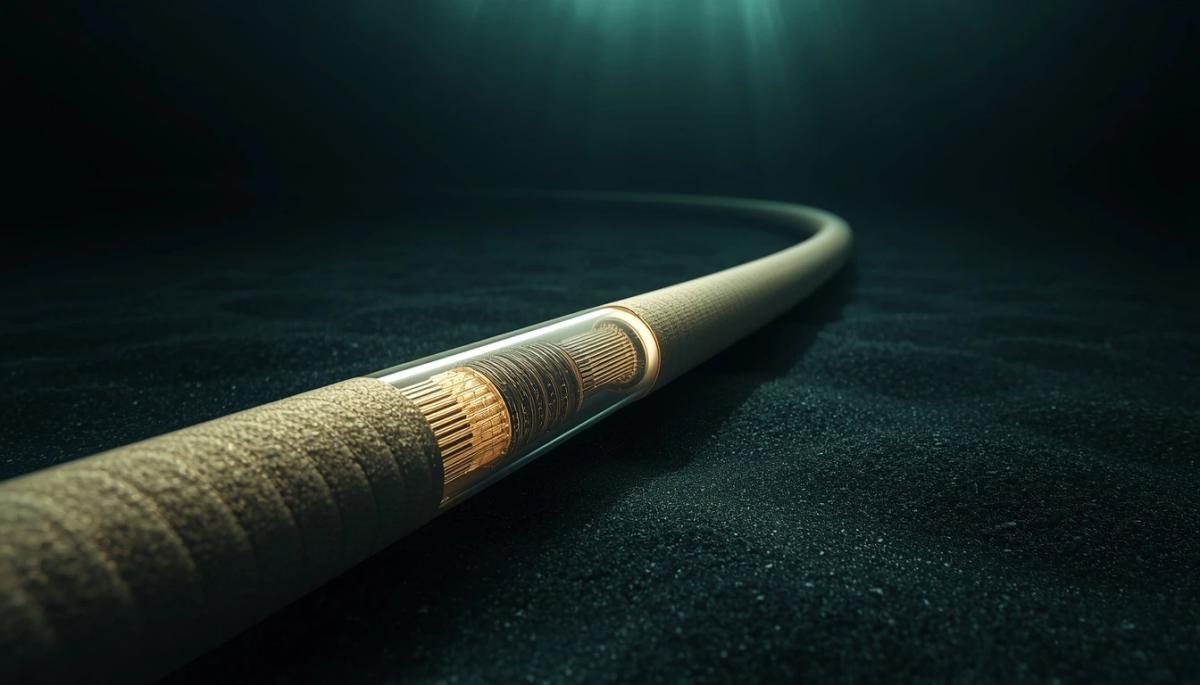
Although about 99 percent of all international internet traffic flows through them, the cable itself is roughly as thick as a standard garden hose. All that vast quantity of information, from vital government messages to simple videos of cats, must fit within this inconspicuous dimension.
Light pulses inside the glass hair
Upon examining beneath the protective casing, we discover that the most crucial activity happens right at the core. Inside lie bundles of glass fibers as thin as human hair. Data is transferred within them using laser beams vibrating billions of times per second, propelling information forward at speeds approaching the speed of light.
Experts can also send dozens of different colored beams through a single fiber, each carrying a different data segment. So, your email and someone else's video call travel alongside each other within a single glass strand. One cable is thus capable of transmitting an unimaginable amount of information in a split second, allowing data to travel from New York to Sydney or Hong Kong to London faster than it would take you to read a single word.
Given the vast distances, however, light tires on its journey. Hence, special boxes are placed along these routes to boost and amplify the weakening signal as required.
The journey from the sea to your phone
This entire process happens so quickly that you don't even notice it during regular browsing. When connecting to the internet, your phone or computer wirelessly connects only to the nearest transmitter or home router. From there, the data travels over traditional mainland cables, which then converge at giant technological centers.
These centers are directly connected to marine cables. Although satellite internet is experiencing growth, it still accounts for just a minor fraction of the total global traffic, as underwater glass fibers remain the fastest, most reliable, and most cost-effective way to connect continents.
Cable anatomy - what must it endure?
For the delicate glass fibers to serve their purpose in the harsh oceanic environment for up to twenty-five years, they require extreme protection. The manufacturing process in factories resembles heavy engineering more than anything else.
The glass core is first wrapped with copper. This is vital because it conducts electricity along the entire route, powering those boxes that boost the signal underwater. Subsequently, other strong layers made of plastic, sturdy steel cables, and protective tar are added. The final product must withstand powerful deep-sea currents, underwater landslides, and even earthquakes.
A month in the hold and sailing at a walking pace
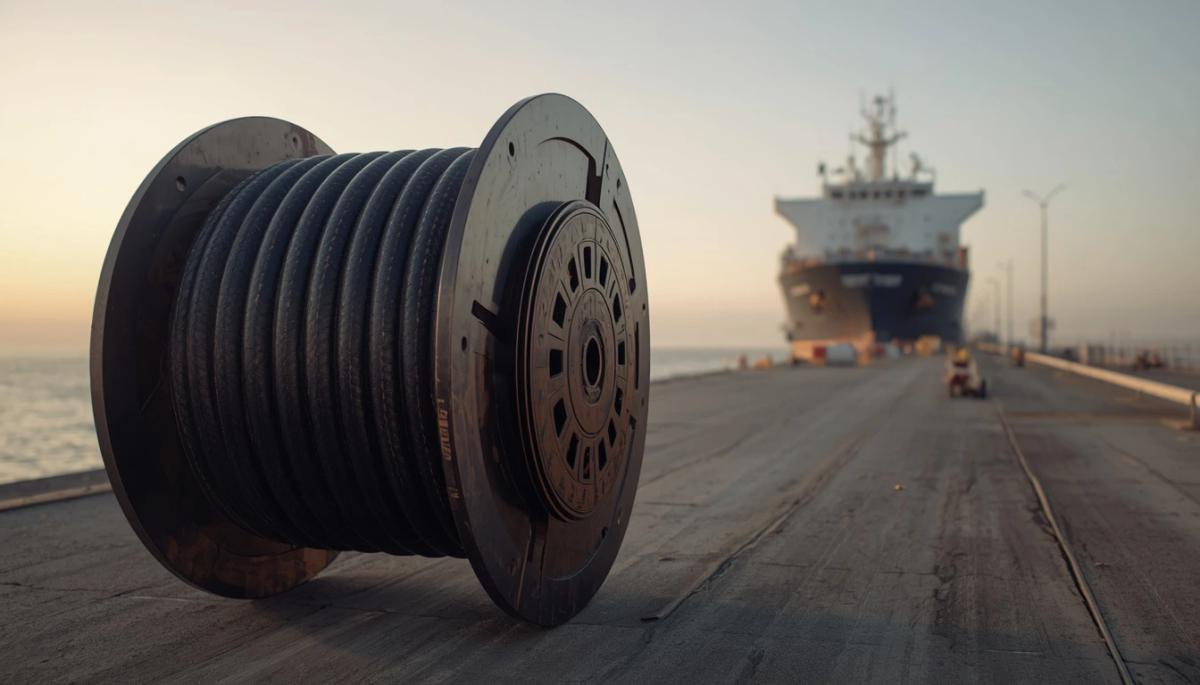
Placing such a colossus on the seabed is a huge challenge that requires months of planning, seeking routes without sharp rocks and other natural obstacles. The actual laying begins in the port, where the cable is threaded using conveyors directly into giant circular storage tanks in the holds of specialized ships.
Workers in these spaces must manually coil thousands of kilometers of cable into perfect loops to prevent tangling during deployment. One person literally runs around with the cable, while others guide it. This human labor goes on non-stop in twelve-hour shifts, and it takes about four weeks to fill one ship.
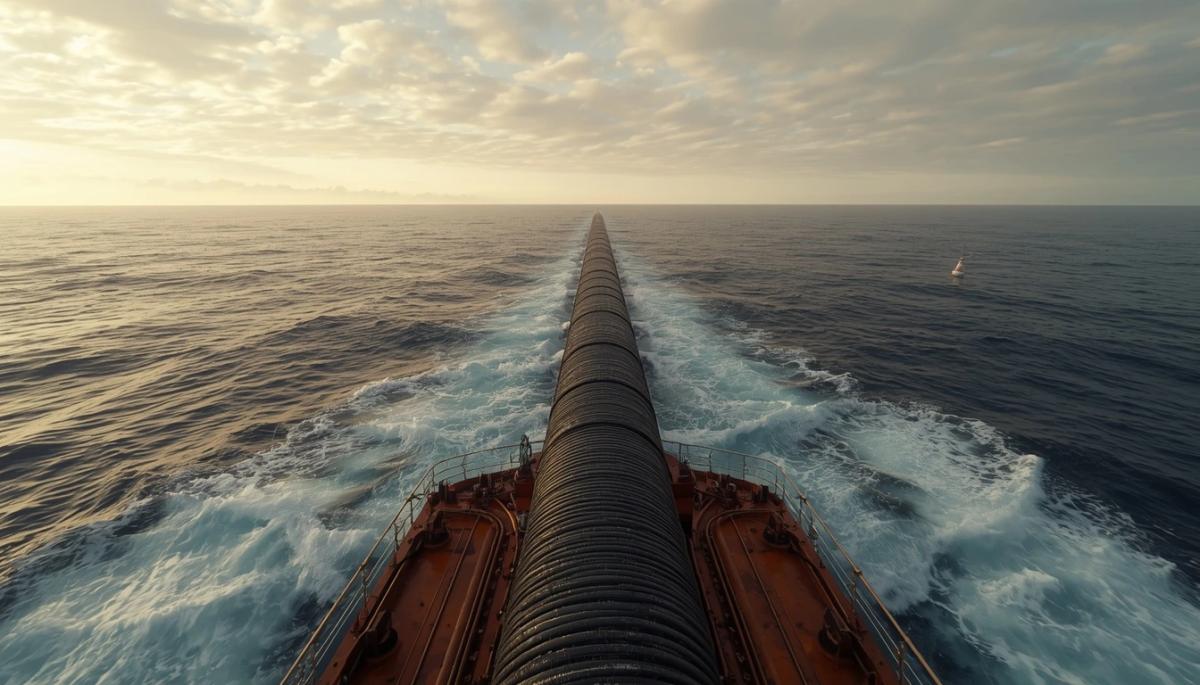
The loaded vessel then transports a cargo weighing thousands of tons. In open sea, the ship moves at a snail's pace around ten kilometers per hour, akin to a light jog, and slowly releases the cable from its stern. When it approaches the coastline, where the risk of damage is greatest, an underwater plough takes over to safely bury the cable in the seabed.
If the crew encounters a powerful storm with massive waves, the captain must cut the cable, tie it to a floating buoy, and sail to safety. Once the weather calms, the ship returns, retrieves the end, splices it, and the process continues.
When an anchor breaks the digital world
Despite all the steel armor, there are 150 to 200 incidents annually worldwide where a cable gets damaged. Occasionally, it's a natural force at fault, like in 2022, when a volcanic eruption left the Pacific island of Tonga completely disconnected for over a month.
However, 80 percent of disruptions are attributed to human activity. Often, it's due to careless fishing boats or dragged ship anchors capturing and breaking the cables.
Most countries luckily have backup routes available, so a regular user doesn't notice when one line experiences an outage. The problem arises in remote areas dependent on a single connection.
Repairing a damaged section is technically demanding, but often it's even more complicated to obtain the necessary permits from authorities if the cable lies in overlapping jurisdictions and interests of different states.
Retrieving the TAT-8 cable and the new race for the seabed
Cables have their lifespans, and the old ones occasionally make way for new technologies. An example is the first-ever glass fiber submarine cable dubbed TAT-8, connecting America to Europe in 1988. It ended service in 2002 due to a technical issue but wasn't fully retrieved from the Atlantic depths until after a lengthy twenty-four-year rest on the seabed.
The main reason for hoisting it was to recycle valuable copper and free up a desirable submarine route for its modern successors.
This process highlights how much the world has evolved. While the first transatlantic link in 1858, letting Queen Victoria exchange a message with the US president, was funded and built by governments and took 16 hours to transmit, today's network is being taken over by private technological giants.
Companies like Google, Microsoft, Amazon, and Facebook now own or lease more than half of all space in these submarine cables. Building their own ocean-floor highways grants them independence and speed for their data centers.
However, the entire project has simultaneously become a closely watched political tug-of-war. Governments see these cables as critical infrastructure and fear espionage or damage by foreign powers.
Australia, for instance, previously blocked the Chinese company Huawei from constructing a line to the Solomon Islands for fear that the Chinese government would gain access to the local networks.
The physical foundation of a wireless world
The demand for submarine highways continues to grow as more millions of people connect to the internet. Online services, advanced artificial intelligence, and autonomous vehicles will demand even larger volumes of data and minimal latency.
So next time you pick up your phone and wirelessly open any webpage, think of those thousands of kilometers of steel conduits with a glass hair inside, silently holding our digital world together deep beneath the ocean’s surface.
WPA, WPA2, WPA3: Which Wi-Fi security should you use today?

WPA, WPA2, WPA3, AES or TKIP? Wi-Fi security settings might initially seem unnecessarily complicated. However, when you understand what each abbreviation stands for, it becomes fairly simple. Therefore, we'll explain the differences between them and which is the best choice today. We'll also suggest what settings to choose if you have older devices at home that don't support the latest standard.
Is incognito mode really anonymous? Who still sees what you're doing

Do you think incognito mode hides you from everyone on the internet? In reality, it works a bit differently. We explain what it actually does, when it's sensible to use it, who can still see your activity, and whether history can be traced in incognito mode.
Why Does AI Hallucinate? A Peek Under the Hood of Language Models

AI can answer almost any question in just a few seconds. However, sometimes it confidently states information that is not true. Why does this happen and what are so-called AI hallucinations? In this article, we'll explain how large language models work, why they sometimes create false answers and how developers are gradually trying to mitigate this issue.
What is a CDN and why is internet content copied worldwide
Behind every loaded video, photo, or webpage is a technology called CDN. It is used by streaming services, social networks, and regular websites, yet many people have never heard of it. In this article, we will explain what this abbreviation means, how it works, why internet content is stored in various locations around the world, and why today's internet can hardly do without it.
Who will inherit your photos, emails and accounts? Digital legacy is rarely addressed

When talking about inheritance, most people think of a house, a car or money in the account. Yet we also leave behind thousands of photos, emails, social media accounts or data stored in the cloud. What happens to them after death, and who will gain access to them? This article looks at how digital legacy works, why the bereaved may have problems with data, and how to get organized in your online footprint today.
Why Subscription Fatigue Troubles Us and How to Stop Money Disappearing in 4 Steps

How much money leaves your account each month for online services? The recurring payment model often exhausts people because numerous small amounts gradually add up to unexpectedly high totals. The text relies on fresh data from 2026, reveals the vast difference between our estimates and reality, and offers four specific steps to help you better control your expenses.