 ▾
▾Does the storm affect the quality of the internet connection?
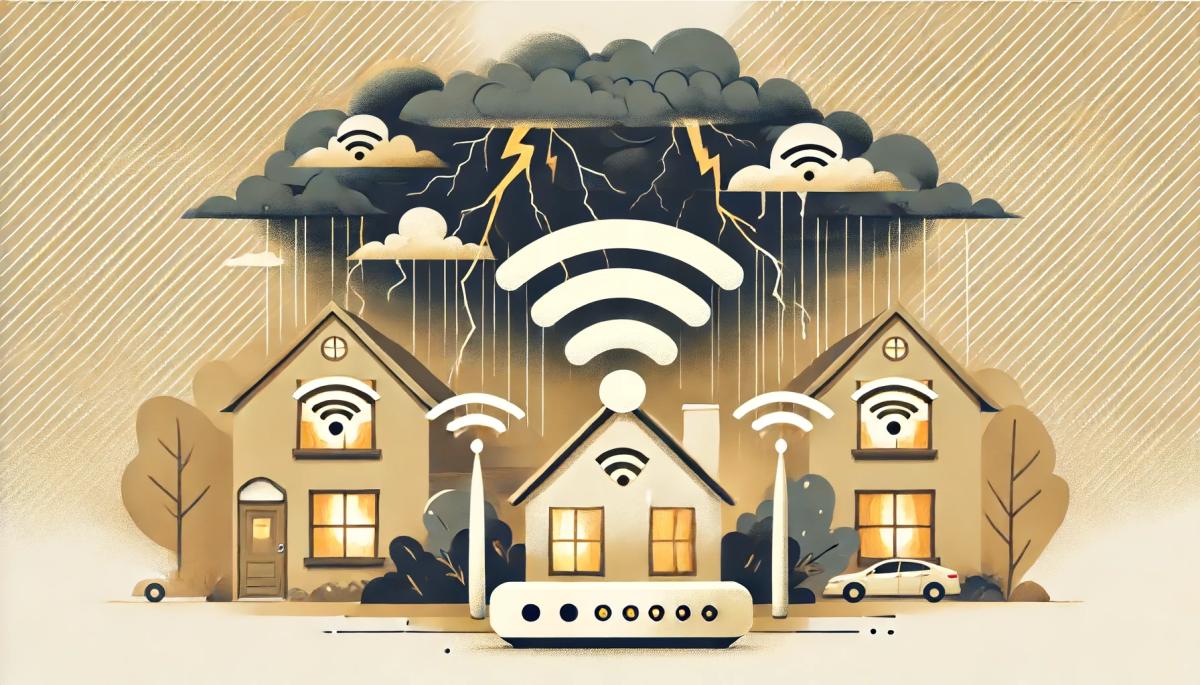
We are often subconsciously scared of the storm, do you have that feeling too? And especially in the summer, when the sky suddenly clouded over and the dark, blue and grey clouds appear in a moment, windless conditions turn into intensifying gusts of wind and it is not far to the first thunder. Come to find out if the vagaries of the weather affect the quality of your internet connection.
One never knows
Thunderstorms are unpredictable. Because they are accompanied by lightning strikes, they can be very dangerous for technology, especially for electronics. Such lightning has a great effect on all electrical equipment, not only at the point of impact, but often quite far in the vicinity. If lightning strikes an electrical line or other conductor (such as a telephone or data cable), a very high overvoltage can occur, resulting in the destruction of connected electrical appliances in a wide area. Of course, every house has a lightning conductor and fuses, but that will not protect you 100%.
Disconnect cables
Of course, you wouldn't help much yourself with superstition, but completely ignoring the coming rampage of natural forces is definitely not a good idea, electronics are very sensitive to these interventions and sometimes a little is enough. Disabling the fuses themselves certainly does not protect devices that are connected via antennas and other connecting cables. There is no such high risk of mobile devices, but if you use wired internet connected via telephone lines, it is definitely necessary to disconnect the modem in the event of an approaching storm. It is also suitable to disconnect all devices with screens, monitors, electrical appliances with motors (washing machines, refrigerators, freezers, mixers, coffee machines, etc.). Even a high-quality UPS with so-called over voltage protection is not a 100% guarantee that no damage will occur. For television sets, it is of course necessary to disconnect the antenna cable as well. Due to the high voltage caused by lightning, by the circuit breaker can be skipped a discharge even between the open contacts when the circuit breaker is switched off. Of course, you should also disconnect the router and other devices from the outlet.
Pay attention to the location of the antennas!
During the installing the antennas, the antenna itself on the mast or the so-called "boom" and all conductive elements must be conductively connected, this also applies to their individual components. Furthermore, for installation, high-frequency or other communication cables must not cross the main outlet of the installed lightning conductor. In the case of parallel lines, a distance of at least two meters must be observed. This is not an unnecessary regulation, as this arrangement minimizes the possibility of inducing a discharge passing through the lightning conductor into these cables. Of the other standards, lightning protection is important (this is the real name, you can find it under the designation ČSN EN 62305–3). The standard is quite extensive, it is certainly important for you that any mast on the roof must not exceed the tops of the collecting rods and must have an end in the form of a lightning rod. This is especially important if you install a Wi-Fi network with a lange range yourself.
Internet problems can occur immediately after a storm
Do you have problems with connecting? n such a case, the first is the optical inspection, especially for antennas and other elements that are located on the roof, on the chimney and like that. Sometimes, for a signal loss or a significant attenuation, a change in the position of the antenna or receiver is sufficient, which can be caused, for example, by strong gusts of wind. Another possibility is mechanical damage, which we discover only after a thorough inspection of the device, which is not always completely accessible. In the event of a stronger storm, water may enter the wiring or connectors if it is not dried properly and in good time, which is a possible cause of subsequent corrosion and malfunction of the device. Heavy rain, blizzards and wet leaves on the trees can complicate the spread of Wi-Fi signal.
In short, the weather is definitely not good for the quality of your internet connection, and what's more, it can have a really negative impact on it. If possible, do not hesitate to contact your provider directly due to a prolonged outage. He should advise you on what to check and how to proceed.
What is cache and how to clear it

The concept of cache appears in browsers, phone settings, and when troubleshooting websites, but few know what it exactly means. Cache aims to speed up data loading, but sometimes it can be rather a hindrance. Let's explain what cache memory is, how it works in practice, and when it's sensible to clear it.
digital carbon footprint: how the internet and online services burden the planet

Everyday online activities have a real energy footprint that quickly multiplies in total. In the article, we will look at what digital carbon footprint means, how much energy regular internet use costs, and which activities burden the environment the most. Areas where consumption is growing the fastest and impact is not immediately visible deserve special attention.
Is blue light really a problem? The answer isn't so simple

The topic of blue light has led to many simplifications and unnecessary fears. Blue light exposure before sleep is often discussed, but its impact is not limited to just sleep. Let's put things in context, separate facts from myths, and see when it makes sense to address its effects and when it is more about excessive concern.
Are you chatting with a human or a bot? How to identify AI in chat

Online chats are often handled by artificial intelligence today, and at first glance, the responses appear to be from a real person. This is especially true for customer support, where speed and fluency are key. We'll look at how to identify AI in chat, what signs you can use to distinguish it from a human, and where the line of recognition becomes very thin.
What is ransomware and why does it no longer threaten only large companies?

Ransomware attacks are among the most common cyber threats today and are no longer just a concern for large companies. Just one careless click can cost you access to your data. We'll explain what ransomware is, how it works, and why attackers are increasingly targeting average users and smaller businesses.
How zero trust works: why mere connectivity no longer means safety

Connecting to the internet today is not just a matter of speed but also of trust. Networks handle more and more devices, sensitive data, and services that communicate almost constantly. This is why an approach called zero trust has emerged, where nothing is automatically considered safe. The article explains why this model was created and how it subtly influences everyday internet functioning.