 ▾
▾Scratch: a great tool for beginner child programmers
Do you want your child to learn the basics of programming in a fun and accessible way? Scratch is the ideal starting point. This visual programming language allows children to create games, animations, and stories without the need to write complex code. They will learn the basics of logical thinking and creativity, opening doors to real programming.
Programming is being talked about more and more often, even in schools. If you want to prepare your child for the future, you are in the right place. We have prepared a series of articles for you in which we will introduce you to available applications and programs that will help turn your children into experienced programmers. Today, we take a closer look at the popular program Scratch.
What is Scratch?
Scratch is a free visual programming language designed specifically for children, so they can understand the basics of programming simply and enjoyably. It is a platform that enables young users to create interactive projects—such as games, animations, stories, or artworks—without the need to write complex code.
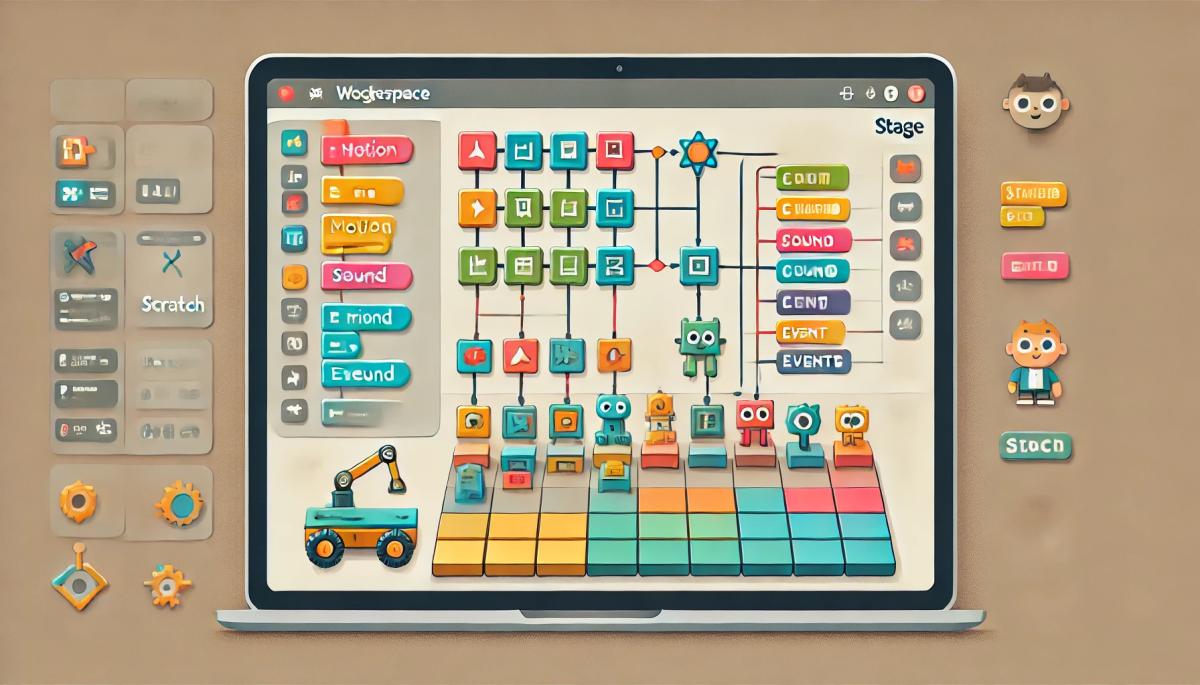
Instead, it uses graphical blocks that are easily dragged and connected. Each block represents a specific command or function, such as moving a character, changing color, or reacting to mouse clicks. The blocks are designed to be intuitive and easy to understand, allowing children of all ages to use the program.
How does Scratch work?
As we have already mentioned, all projects in Scratch are created using blocks. These are divided into several categories according to their function—such as movement, appearance, sounds, events, or control. Children can start with simple projects and gradually add more complex functions.
For example, they can create a game where a character reacts to mouse clicks, or an animation that starts when a certain button is pressed. Scratch allows children to develop not just their programming skills but also logical thinking and problem-solving abilities.
When deciding how they want their project to look and what it should do, they have to think about how to link individual actions and how to adjust the behavior of characters or objects according to different conditions.
Advantages of Scratch
Scratch is an ideal tool for beginner programmers, especially children. Visual blocks replace complex code, allowing children to focus on the logic and structure of programming without worrying about writing commands. Another big advantage is that it fosters creativity. Children can create their own characters, stories, and animations, which allows them to experiment while learning basic programming principles.
Such an approach motivates children to engage in their own projects, which is not only fun but also develops their ability to think creatively and solve problems. Scratch also effectively teaches basic programming concepts such as sequences, loops, conditions, and variables, which are key concepts for later learning of more complex languages.
In addition, they receive immediate feedback, teaching them where they might have made a mistake. Scratch also offers a wide and active community where users can share their projects, find inspiration, and collaborate.
Disadvantages of Scratch
Scratch is a great tool for beginner programmers, but compared to other platforms such as Tynker, Minecraft: Education Edition, or Alice, it has some limitations. For example, Tynker offers more structured courses focused on specific areas such as robotics or game development.
Minecraft: Education Edition connects programming with playing in a gaming environment, which can be attractive for children who want to learn through interactive fun. Alice, on the other hand, allows work with 3D animations and games, which Scratch does not offer. Overall, Scratch is suitable for complete beginners.
How to start with Scratch?
Starting with programming has never been easier, and if your child wants to dive into the world of digital creation, Scratch is the ideal starting point. The first step is to visit the official Scratch website, where you can create a free account.
Once registered, children can save their projects, share them with other users, and receive feedback from the community. However, if they prefer, they can use Scratch without registration, which is ideal for a first encounter.
After logging into Scratch, children will access a clear interface where they can quickly find their way around. The main editor offers a wide palette of colorful blocks that are simply dragged into the workspace to be arranged into sequences.
For complete beginners, a wide range of instructions and tutorials are available to guide them step-by-step on how to start. Once they master the basics, they can move on to more complex projects and experiment with new ideas.
What would happen if the internet went down for a day?

What if there was a full-day internet outage? An immediate collapse of society wouldn't occur, but daily operations would quickly become complicated because today's world is more dependent on the internet than we often realize. Which services would stop functioning first, and what would happen with payments, transportation, or work?
WPA, WPA2, WPA3: Which Wi-Fi security should you use today?

WPA, WPA2, WPA3, AES or TKIP? Wi-Fi security settings might initially seem unnecessarily complicated. However, when you understand what each abbreviation stands for, it becomes fairly simple. Therefore, we'll explain the differences between them and which is the best choice today. We'll also suggest what settings to choose if you have older devices at home that don't support the latest standard.
Is incognito mode really anonymous? Who still sees what you're doing

Do you think incognito mode hides you from everyone on the internet? In reality, it works a bit differently. We explain what it actually does, when it's sensible to use it, who can still see your activity, and whether history can be traced in incognito mode.
Why Does AI Hallucinate? A Peek Under the Hood of Language Models

AI can answer almost any question in just a few seconds. However, sometimes it confidently states information that is not true. Why does this happen and what are so-called AI hallucinations? In this article, we'll explain how large language models work, why they sometimes create false answers and how developers are gradually trying to mitigate this issue.
What is a CDN and why is internet content copied worldwide

Behind every loaded video, photo, or webpage is a technology called CDN. It is used by streaming services, social networks, and regular websites, yet many people have never heard of it. In this article, we will explain what this abbreviation means, how it works, why internet content is stored in various locations around the world, and why today's internet can hardly do without it.
Who will inherit your photos, emails and accounts? Digital legacy is rarely addressed

When talking about inheritance, most people think of a house, a car or money in the account. Yet we also leave behind thousands of photos, emails, social media accounts or data stored in the cloud. What happens to them after death, and who will gain access to them? This article looks at how digital legacy works, why the bereaved may have problems with data, and how to get organized in your online footprint today.